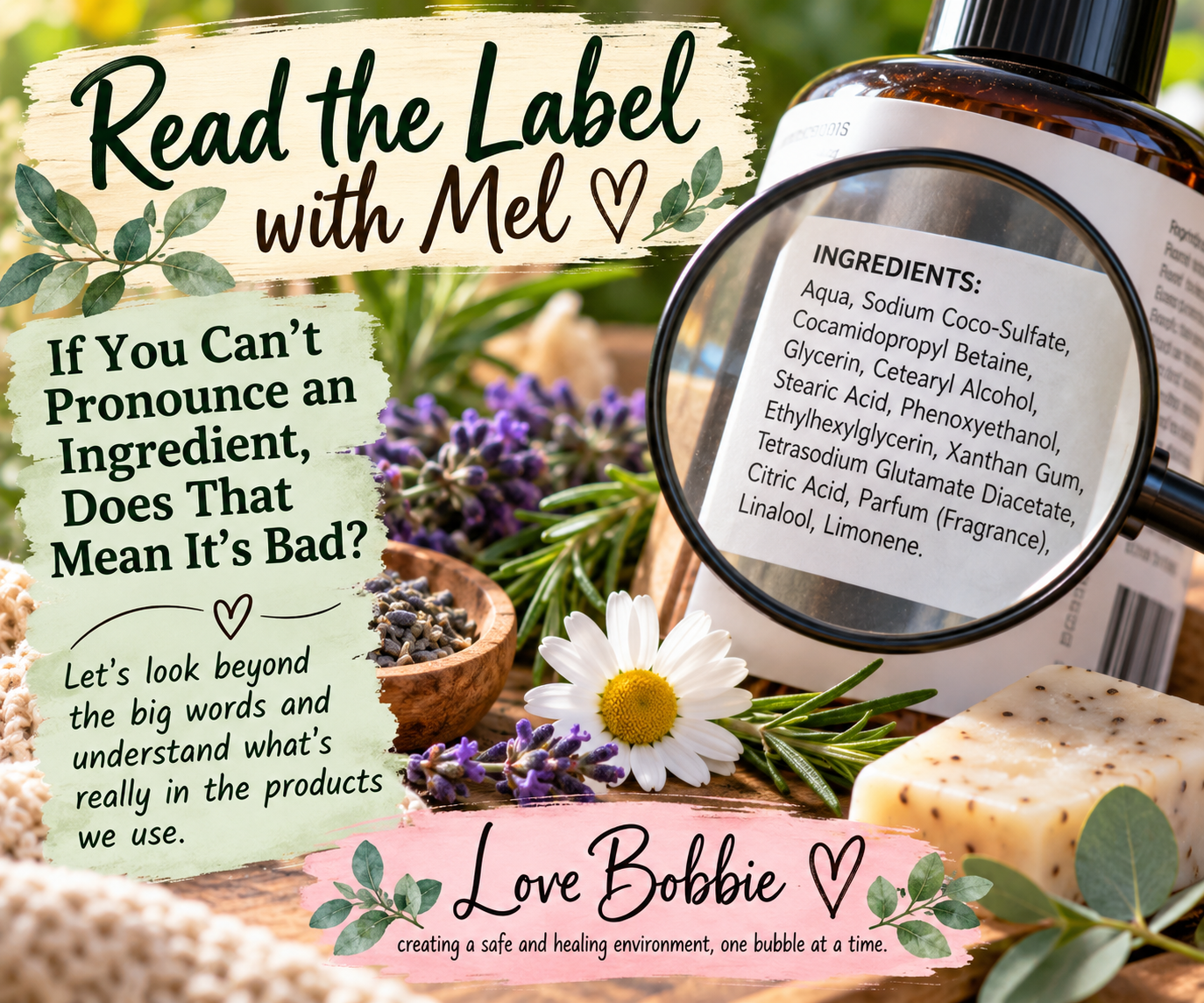
Have you ever turned over a bottle, read the ingredient list and thought, “What on earth is that?”
You’re certainly not alone.
Over the years, I’ve had so many people ask me about ingredients simply because the names looked long, scientific or impossible to pronounce.
And I understand why. When we don’t recognise a word, it’s easy to assume that it must be something harsh, artificial or unsafe.
But here’s something I would really like more people to know:
A difficult-to-pronounce ingredient isn’t automatically a bad ingredient — and a familiar or natural-sounding ingredient isn’t automatically a safe one.
The name alone doesn’t tell us enough.
What matters is understanding what the ingredient actually is, why it has been included in the product, how it’s being used and what reliable evidence tells us about its safety.
That’s what Read the Label with Mel is going to be about.
I’m not here to create fear. I’m here to help people learn.
That doesn’t mean I’m going to tell you that every ingredient is wonderful, either.
I have concerns of my own about some ingredients, particularly our reliance on petrochemical-derived materials. Those concerns aren’t simply about whether an ingredient is considered safe to use in a cosmetic product. I also care about the bigger picture — where our raw materials come from, how they are extracted and manufactured, and the effects those industries can have on our environment, wildlife and plant life.
At the same time, I don’t want to label an ingredient as dangerous simply because its name sounds unfamiliar or because it was made in a laboratory.
There is a difference between asking, “Is this ingredient safe when used in this product?” and asking, “What is the environmental cost of producing and using this ingredient?”
Sometimes we need to ask both.Read the Label — Without the Fear
So What Should We Look for on an Ingredient Label?
When I read an ingredient label, I don’t simply divide the ingredients into good and bad. I start by asking questions.
What is the ingredient?
Is it derived from a plant, mineral, animal source, petroleum, or has it been manufactured or modified in a laboratory?
Why is it there?
An ingredient may be included to cleanse, moisturise, preserve the product, adjust its pH, create texture, add fragrance or perform another important function.
How is it being used?
The amount of an ingredient, the type of product it’s in and how we’re exposed to it all matter. Something used in a rinse-off product may need to be considered differently from something that remains on our skin.
What does reliable evidence tell us?
Rather than judging an ingredient because its name sounds frightening — or trusting it simply because the label says natural — I want to look at what good evidence actually tells us.
And what about the environmental impact?
Where appropriate, we’ll also look beyond the bottle: where the ingredient comes from, how it is produced, whether there are environmental concerns associated with its manufacture or sourcing, and what happens after we wash that product down the drain.
That’s how I want us to Read the Label — with curiosity, not fear.
Natural Doesn’t Always Mean Safe — and Synthetic Doesn’t Always Mean Harmful
Plants, minerals and other naturally occurring materials contain chemicals too. In fact, everything around us — including water, the air we breathe and our own bodies — is made of chemicals.
So the word chemical doesn’t mean dangerous, just as the word natural doesn’t automatically mean safe.
Nature produces some incredibly useful substances, but it also produces irritants, allergens and toxins. Essential oils are a good example of why we need to understand an ingredient rather than simply assuming that natural means it can be used in any amount or in any way.
The same principle applies to synthetic ingredients. Something being manufactured in a laboratory doesn’t automatically make it harmful. We need to look at the individual ingredient, its purpose, the amount being used and the evidence surrounding it.
For me, informed choice sits somewhere between fear and blind trust.
I want to understand what I’m using, where it came from and why it’s there — and then make my own decision.
What We’ll Discover Together
In future Read the Label with Mel articles, we’ll take ingredients that commonly appear on the products in our bathrooms, laundries and homes and look at them one at a time.
We’ll ask what the ingredient is, where it comes from, why manufacturers use it, what reliable evidence tells us about its safety and, where relevant, what environmental concerns may be associated with its sourcing, manufacture, use or disposal.
Sometimes we may discover that an ingredient with a frightening-looking name isn’t nearly as frightening as it first appeared.
Other times, we may find genuine reasons to question whether an ingredient or product fits with the choices we want to make.
And sometimes the evidence simply won’t give us a neat yes-or-no answer.
That’s okay too.
I don’t want to tell you what you should think. I want to give you information worth thinking about.
Then you can turn that bottle around, read the label and make an informed choice for yourself.
Respect the science. Embrace the art. Enjoy the surprise.
Creating a safe and healing environment, one bubble at a time.
Love Bobbie